Showing posts with label Military Sci FI. Show all posts

Friday, April 20, 2012

Sisters of Battle: Faith and Fire, Hammer and Anvil & Red and Black by James Swallow


When dangerous psychic Torris Vaun escapes from her custody, Celestian Miriya is disgraced in the eyes of her fellow sisters and superiors. Following Vaun’s trail to the planet Neva, Miriya takes her sisters in pursuit and, along with Hospitaller Sister Verity, starts her investigations.

When they uncover a terrifying a plot that could threaten the future of the Imperium, is Miriya’s and Verity’s faith strong enough for them to triumph?


I first read Faith and Fire back in 2006, when it was first published, and remembered enjoying it then. When I heard that there was a sequel in the offing, I discovered that my copy had vanished, either lent to a ‘friend’ or eaten by the sofa, and horror of horrors, it was out of print. Thankfully eBay came to the rescue, although it’s since been re-printed to coincide with the new releases.
The sequel, Hammer and Anvil, and the audiobook Red and Black, all follow Miriya and Verity, who are both Sisters of Battle, who are essentially militant nuns. Very, very militant nuns, each sworn to the service of The Emperor and possessed of a penchant for alternately blowing very large holes in heretics or setting them on fire. And, importantly, they’re human. Not Space Marines, but good, old fashioned humans, albeit highly trained and equipped with top of the range weaponry. SEAL nuns then, with powered armour and the tolerance for blasphemy that makes the Taliban look like a commune of free-spirited hippies.

Amongst their order, Miriya is known to be a headstrong commander, one not afraid to ask questions that others would deflect or ignore. But she’s a good soldier, and devoted to her cause. Vaun’s escape is ruthlessly executed, but far worse than the censure of her superiors is the memory of being held captive by his warp-craft and forced to watch his callous desecration of her sisters in impotent rage.

What begins as a personal quest for redemption and revenge leads her onto an unexpected path, thick with secrets and danger as she is forced to confront uncomfortable truths about those she serves as well as herself. The truth of what Vaun is seeking is an ingenious and ambitious twist, one that makes the conclusion a bittersweet one truly in keeping with the spirit of the universe. It’s a perfectly satisfying standalone read, but the strength of the characters has always called out for more of their stories to be told.

Hence Hammer and Anvil.


On a distant world, the Ecclesiarchy outpost of Sanctuary 101 was wiped out by an implacable foe- the fearless, soulless Necrons. Now, a mission of the sisterhood has returned to reconsecrate the site- but the metallic nightmares still lurk in the darkness, guarding a secret that has lain dormant for millennia.

A vicious battle will be fought, one that only end in the total destruction of the unrelenting xenos, or the annihilation of the proud Adepta Sororitas.


Hammer and Anvil is set some years after the events of Faith and Fire, and we rejoin sisters Miriya and Verity as they join the mission to reclaim Sanctuary 101, a mission that has been delayed by long years of political manoeuvring and stonewalling by the Inquisition. Each is seeking their own redemption, although Miriya’s path is the harder one as she seeks to put the ghost of Vaun’s actions behind her once and for all, while fearing that she never will.

The truth of what happened at the Sanctuary is quickly figured out, and even as the indentured workers begin the reconstruction the scheming minions of the Mechanicum set a chain of events in motion that will see the Sisters draw weapons against both them and the fearsome Necrons who have been roused from their sleep. But this isn’t just any tomb-world of that age old and forgotten race; it holds the key to unleashing the kind of force that saw the Necrontyr dominate the galaxy countless aeons ago. War soon returns to Sanctuary 101, and it’s clear that not even the tenacious defiance of the Sisters will be enough to stave off disaster.

Beset by self-doubt, and surrounded by distrustful Battle Sisters, a damaged escapee from the Necrons’ cruel research and a self serving techpriest, Miriya’s battle is fought on several fronts, all of them desperate. H & A flies along at a frenetic pace as the truth and intriguing glimpses into the history and lives of the key Necron figures are teased out, all leading to a massive and breathless confrontation. Happily, despite the years since Faith & Fire did the rounds, Swallow has kept Miriya and Verity true to the original characters and as interesting as before (although Miriya wins, hands down) and has maintained the background feel of the intrigue and one-upmanship that are so rife in the Imperium. Hammer and Anvil stands on its own and can be read alone, although you will get far more out of it by having read Faith & Fire.

The Nuns-With-Guns trifecta is completed by Red and Black, an audio drama featuring Miriya again, who is at the rank of Celestian again, which suggests this is a prequel to Faith and Fire, although to be honest it again works as a standalone.


After two millennia, the warp storms raging around the Hollos star system have abated, allowing the isolated planet of Hollos to reconnect with the Imperium. When a mysterious messenger contacts the Orders Militant, Celestian Miriya must travel to Hollos and pass judgement on the world. Will she find a world embracing the Emperor’s truth or one in need of cleansing? Her decision will liberate or condemn an entire planet.

Miriya’s ‘flaw’ of being willing to think for herself is one of the factors that sees her put forward to lead this expedition. It’s a heavy responsibility and one that’s never far from her mind; Hollos will live or die by her judgement.

The expedition has a promising start. The envoy shows a devout belief in the Emperor, and the landing pad on the prosperous capital city of Hollos is thronged with cheering crowds. But soon enough things go awry and Miriya and her sisters find themselves fighting off a faction of extremists, the presence of whom raises a score of questions as to the price the inhabitants have paid for the facade of peace and prosperity that they enjoy- and the price they will have to pay for their survival. The history and secrets that lie at the heart of Hollos are systematically revealed by the not-so-delicate investigations of the Sisters and their accompanying tech priests, yet as she gets closer to the judgement she must pass Miriya finds that the decision will be harder than she would ever have expected.

It’s not an action heavy drama, but James nonetheless crams a lot into the 71 minute running time. It’s an interesting concept and one that could easily have been expanded into a full length novel. Beth Chalmers and Lisa Bowerman’s performances are consistent, clear and spirited, and the background effects are handled well, neither overwhelming the narration nor becoming repetitive. You can listen to a sample here.

I transferred this onto my ipod and listened to it while at gym, which worked out perfectly. It’s the right length for a casual, one-off listen and an easy way to get a 40K fix on the go. The Sisters of Battle provide a nice change of perspective, and if you're new to the 40K universe and worried about trying to coming to grips with the physio- and psychology of superhuman Space Marines, the Sisters are a good introduction to the setting and mindset... and the kick-ass, no holds barred action that makes 40K so addictive. I guess that makes them a gateway drug :) but what a rush!


You can visit James' Livejournal site here, read an extract of Faith and Fire here or Hammer and Anvil here.

Friday, February 10, 2012

Know No Fear by Dan Abnett


Unaware of the wider Heresy and following the Warmaster’s increasingly cryptic orders, Roboute Guilliman returns to Ultramar to muster his Legion for war against the orks massing in the Veridian system. Without warning, their supposed allies in the Word Bearers Legion launch a devastating invasion of Calth, scattering the Ultramarines fleet and slaughtering all who stand in their way.


And so begins the 19th book of the Horus Heresy series.

The first thing you notice is that KNF is presented in the style of a chronicle of the battle of Calth rather than an out-and-out novel like its predecessors, the heading of each chapter showing the countdown to when Guilliman, Primarch of the Ultramarines, gives the order to return fire. It’s a very clever device, adding to the tension as the Word Bearers make their final preparations amidst the unsuspecting Ultramarines who are denied the reader’s knowledge. It’s a bold move, perhaps borne of the fact that the subheading on the cover is ‘The Battle of Calth’, or that ultimately the entire Horus Heresy is a retrospective study of what shaped the 41st millennium into the no-hugs-just-war hellhole that the rest of 40K is set in. Whatever the root of the idea, it works. This is a huge confrontation, one that ranks right up there with the Dropsite Massacre in terms of impact, and it deserves the epic tone that this approach gives it. It’s tricky to put exactly why and how it works into words, but it does (hence Dan being the NYT bestselling author and not me).

It’s a hybrid approach, made up of varying percentages of found footage, military report and typical third person narrative, and what that does is enable Dan to convey the sheer scope of the battle while seamlessly blending in the facets of the battle from the perspective of a range of Space Marines and troopers scattered across the battlefields. Through their eyes we are afforded a glimpse of uncounted moments of otherwise unseen heroism and bear witness to their deaths. The scope and intensity of the unadulterated violence that is unleashed is no less than awesome. There’s a very real sense of how utterly lethal and unforgiving a battle between Space Marines would be. You can tell Dan was having some real fun with this, and has really pulled the stops out in the action stakes; it’s crisp, dark and relentless, and reaffirms why he’s the crown prince of military sci-fi.

The stars of the show are the Ultramarines and how they react to the invasion as they’re steadily pushed to the brink of destruction. It’s a good insight into their psyche at that time, and an interesting take on how they assess and deal with such threats. Guilliman too gets a similar treatment, and while he doesn’t get as much attention lavished on him as, say, Corax did in Deliverance Lost, he’s nonetheless fleshed out and given more character. And he swears. I hooted with childish glee when Lorgar resorts to calling him a “giant pompous arsehole”. Thank you, Dan. They’re Primarchs. Soldiers, albeit on a scale we can’t really appreciate, but they’re not saints.

KNF clocks in at a respectable 412 pages and is a novel of epic, brutal proportions. I finished it over two days of commuting, including two jealously guarded lunch hours where I sat transfixed by blood, betrayal and heroism next to my cold and forgotten coffee. To say that I enjoyed it is an understatement, and my only complaint is that I want more.


You can watch the trailer here, read an extract of KNF here and visit Dan's blog here.

Remember that Dan will be at Games Workshop Plaza, Oxford Street on the 18th Feb (starting at 12 noon) where he'll be signing of Know No Fear!

Wednesday, January 25, 2012

The Gildar Rift by Sarah Cawkwell

When the ancient warship Wolf of Fenris emerges from the warp, Imperial forces find that it has been overrun by the dreaded Red Corsairs. However, this is no mere raiding party – Huron Blackheart and his entire renegade fleet soon follow, intent on conquering the Gildar Rift and tightening their grip on the sector. Lance batteries and torpedo salvos burn fiery contrails through the void, and only Captain Arrun of the Silver Skulls Space Marine Chapter can halt the renegades’ advance. The fate of the Rift will not be decided in the heavens but on the surface of Gildar Secundus below.

Space Marines are cool. So are pirates.

So imagine the possibilities offered by the idea of Space Marine Pirates, particularly when they're a band of chaos worshipping superhumans led by an even larger, wholly psychopathic specimen who's crazier than a bag of possessed possums. And these are exactly what young Ms Cawkwell gets to play with in this, her debut novel.

TGR opens with the calm before the storm, introducing us to the 'Rift, which is a treacherous stretch of space surrounding a planetary system rather than a valley. It's a system thriving (as much as anything in that bleak future thrives) under the protection of the Silver Skulls chapter of the Space Marines. Their fleet is at the forefront of that defence, a fleet led by Captain Daerys Arrun, a veteran who already has enough on his plate without the puzzle posed by the arrival of the battle- damaged ship The Wolf of Fenris. Impossible to ignore, the Silver Skulls mount an expedition into its cold and apparently lifeless interior, but it's soon revealed as the opening gambit for an invasion by Huron Blackheart and his Red Corsairs. Battle is joined, and the cold vacuum of space is lit by lasers, torpedoes and exploding ships in a very nicely described bit of deadly stellar ballet. Blackheart might be batshit crazy, but that hasn't yet suffocated his strategic genius, and Captain Arrun and the 4th company are soon reminded that it's not over until the fat Marine sings.

Space Marines aren't that easy to write. I've tried it. They don't have days off. They don't do emotions all that well, unless it's rage. If they're not at war, they're training for war. Making them accessible and interesting while staying true to what they are is no mean feat, so it was a relief to find that Sarah has managed to do just that, while also managing to bring the little known Silver Skulls to life and make them her own. Captain Arrun and his supporting cast are each given their chance to shine, and the sub-plot with the tragic heroism of Volker was unexpected twist and a very cool concept. Blackheart and his ghoulish apothecary come across equally convincingly, and the interaction between them sparks nicely and I welcomed the fact that they're there for a reason other than generic carnage.

The action's pretty good throughout, although a minor whinge is that I would have liked a bit more Marine vs Marine action in the ground battles- this is a Battles novel and while exploding cultists are always welcome, it would have been nice to have some squad on squad tactical action to get stuck into. Still, there's a cool bike scene, and these are Corsairs- they're not there for a drag out fight. Not yet. There's enough left unanswered to act as a hook for a follow on, but not so much that you're left scratching your head as to what just happened.

The fact that it was a debut novel never crossed my mind when I was reading TGR. It's a good, solid addition to the 40K shelves, suitably grim and dark without being depressing, and I for one am looking forward to seeing what crawls out of Sarah's head next.


You can visit Sarah's blog here, and read an extract from The Gildar Rift here.

Thursday, April 28, 2011

The Purging of Kadillus by Gav Thorpe

++ This is Sergeant Aquila of the Ravenwing. We have encountered heavy resistance: Ork infantry in the hundreds and supporting light vehicles, including crude dreadnoughts. All enemy troops are approaching Koth Ridge at speed. If allowed to continue their advance they may be able to link up with Warlord Ghazghkull and his forces in Kadillus Harbour.

We still have no confirmed visual of the ork landing craft, or their drop zone and cannot confirm that this is the final wave of the reinforcements. The foe will pay a high price for our lives, but Koth Ridge cannot hold. ++

The purging of Kadillus starts as it means to go on: elbows deep in greenskin action. And in several places, elbows deep in a greenskin. Warlord Ghazghkull, still on the rampage after the Armageddon conquest, has turned his sights on Kadillus, his numbers bolstered by a large Bad Moon warband and a secret, unexpected technology.

What he hasn’t quite reckoned on is the Dark Angels garrison at Kadillus and their bloody minded tenacity. Grossly outnumbered and wrong-footed by Ghazghkull’s rapid advance and seemingly endless reinforcements, the Dark Angels are pushed to the limit to contain the Ork threat. Utilising every weapon in their arsenal, from daring scout raids, to last-man-standing defensive actions, armoured assaults, orbital bombardments and deep striking terminator assaults, all kinds of mayhem are unleashed and Gav has stuffed Purging with enough exploding vehicles, bodies and melee carnage to make Michael Bay feel grossly inadequate.

As ever though, it’s the interaction between the characters that provides skeleton for everything else to hang on. A small host of characters share the limelight, rather than a single main character, each pertaining to a different aspect of the unfolding conflict. I particularly enjoyed the viewpoint of the scouts and the apothecary – the scouts for their methodical and sensible approach and Sergeant Naaman’s perspective, and the apothecary simply because the unusual choice of character viewpoint, putting a fresh twist on the fighting. What was equally pleasing was that each is distinct and has their thread of the story concluded one way or the other, rather than being left in some kind of literary limbo. It shouldn’t come as a surprise, given Gav’s experience, but it’s always good to see.

It’s damn good fun and very more-ish - I rampaged through it in a single, scone fuelled sitting on a lazy Sunday morning. More please.

You can read an excerpt here.


Thursday, March 24, 2011

Savage Scars by Andy Hoare


Dal’yth. The forces of the Greater Good have established a stranglehold on the planet, and the time has come for the Imperium to move against them. The White Scars lead the ground assault against the tau, launching into combat with speed and fury, shedding blood as they gain ground against their enemies. Meanwhile, the members of the Crusade Council are determined to pursue their own agendas, and their politicking and back-stabbing will place the entire war effort in jeopardy. But little do they know that Inquisitor Grand has more extreme measures in mind, and the White Scars must achieve victory quickly or the cost to Dal’yth will be devastating.

--

I had been meaning to read something else when I wandered over to our long suffering bookshelves, but then I glimpsed that cover, and suddenly I was reading Savage Scars instead. Of course, a cool cover only goes so far. If the writing’s not up to scratch the shiniest cover in the world isn’t worth feth all.

So young Mr Hoare is twice blessed- a cool cover, and the ability to put a damn fine book together. ‘Scars has a very down to earth feel about. The characters are still larger than life, but the action feels nice and gritty, and suitably deadly. Firefights aren’t entered into for the hell of it; they’re treated like the military operations they’re supposed to be, each side testing for the other's weaknesses, and exploiting them. The Tau feel like the Tau: their tactics and weapons are consistent with the background, and they’re not just there as something for the Marines to kill. The contrast between their mentality approach and the inexorable ferocity that typifies the Space Marines is starkly and evocatively portrayed.

The lead character, Sarik of the White Scars, is a pragmatic and cunning veteran, and by slowly fleshing his character out Andy also builds up the image of the Chapter as a whole without having to be too obvious about it. Likewise, his treatment of the Crusade Council and their internecine squabbling is done in a series of broad brushstrokes that fills in the gaps without detracting from the thrill of the action, building up a real sense of the political maneuvering and bureaucracy that threatens everything the men on the ground have risked, or given, their lives for.

There are various threads which run through the novel, pulling the three main components together, and these are nicely balanced out and work together to engender a sense of urgency and tension. My only gripe would be about the Inquisitor- I won’t give any spoilers away here but it would have been nice if his motivations and background were fleshed out a bit more, so that you had a better grip on the question of why. Still, it’s a minor whinge and it certainly didn’t detract from my enjoyment of ‘Scars.

Job’s a good ‘un! I demand more!You can read an excerpt here and watch the trailer here.

Monday, March 21, 2011

Embedded by Dan Abnett


The colony planet of Eighty-Six looks as dull as all its fellow new worlds to veteran journalist Lex Falk, but when a local squabble starts to turn violent, and the media start getting the runaround from the military high command, his interest is seriously piqued.

Forbidden from approaching the battlezone, he gets himself chipped inside the head of a combat veteran – and uncovers the story of a lifetime. When the soldier is killed, however, Falk must use all his resourcefulness to get back home again… and blow the lid off the whole damn thing.
--
It was always going to be interesting to see what direction Dan went in when he slipped off the Black Library reservation, and I was very pleased to see that he was staying firmly in military sci-fi territory.

Embedded is set on a newly colonized world designated ‘Eighty Six’, and set in a future that’s not so far off as to feel remote, and a bit worn around the edges. There’s no obvious info dump waiting in the shadows, which is nice for a sci-fi. But then the concept of colonization of new planets has been out there for a while, so it’s easy enough to get on board with the basic idea about what’s going on. The finer details are gradually eased in along the way as Falk starts nosing around, the scent of a major story lifting him from the bone-deep fatigue that has become as much a part of him as his cynicism.

What gives Embedded that essential air of authenticity is that Dan understands that whatever gadgets and impressively destructive weapons the soldiers on the ground have available, at the end of the day those are just tools, and it all comes back to the men who wield them. It’s their ability to work as a team that makes the difference between success and failure, life and death. The same is true for the story- it’s the characters that make it work, not the geegaws they’re playing with. And again, this is something he keeps in mind throughout; the main characters are sympathetic, well defined individuals you want to care about, more so when the shit inevitably hits the fan. It’s what makes Falk’s unexpected stint in the veteran’s head work so well.

Having said all that, the weapons and equipment are cool. Many of the weapons are almost familiar (in the way a house cat resembles a sabretooth), likely extrapolated from existing weapons systems, but far nastier than anything you’ve seen before. But there are also some new toys, particularly beam weapons that make Star Wars’ blasters look like nerf guns. There’s no such thing as a flesh wound here- the action is furious and hard hitting. The tech isn’t overwhelming, and is as integrated into the character’s day to day lives as mobile phones are in ours; there’s nothing flashy on offer to draw the spotlight away from the characters or the story.

And it’s a great story, a dangerously more-ish mix of corporate engineering and boneshaking action. It feels fresh, it’s accessible to everyone and permeated with the vivid and immersive action that's become Dan's trademark. I devoured it in a couple of days and my only complaint was that there wasn’t more of it! Lovely stuff.

Monday, June 21, 2010

Nemesis - James Swallow

After the horrors of Isstvan V, Horus declares outright war against the Imperium. In the shadows of the Emperor’s Palace, powerful figures convene. Their plan is to send a team of assassins to execute the Archtraitor Horus and end the war for the galaxy of mankind before it’s even begun.

But what they cannot know is that Horus and his dark allies have already embarked on an equally sinister plan of their own.

This is the 13th book in the Horus Heresy series, which I’m happy to say shows absolutely no sign of slowing down. Like its predecessors, Nemesis is an insight into one aspect of the Heresy, in this case the reaction of the shadowy part of the Emperor’s court – the Officio Assassinorum (essentially the Ministry of Assassination). Comprised of six schools, it is the long, sneaky arm of Emperor’s will, silently eliminating enemies of the Imperium. The long shadow cast by Horus’ rebellion forces them to set aside their secretive protocols and work together to accomplish a seemingly impossible task: to kill Horus.

Horus’ fleet has embarked on its voyage to bring the uprising to the gates of the Imperial Palace, sending a bow wave of fear and insurrection ahead of it. Iesta Veracrux and its closest neighbour, Dagonet, are two planets that are starting to experience the fear and uncertainty that heralds the approach of the Sons of Horus. On Iesta Veracrux we meet Yosef Sabrat, a local investigator for the planetary law enforcers, as he heads out towards a crime scene. It’s a vicious, ritualised murder, and he sets about doggedly tracking the perpetrator down. As he does so, it gives James the opportunity to paint a great picture of the life and thoughts of the average Imperial citizen on the ground as the Heresy looms on the horizon.

However, it soon becomes evident that things aren’t what Yosef expects them to be, and the truth comes to light in a blood drenched epiphany that shoots the story in a completely different direction as the nature of the mysterious figure known only as Spear is revealed.

From then on, the game is well and truly on as the strike team of assassins manoeuvre into positions and set the bait for Horus, drawing him to the surface of Dagonet to crush the dying embers of a civil war which they had stoked into a blaze. Given that the outcome of the Heresy is already well documented, it was always going to be interesting to see how James would tackle the money shot. The six assassins are interesting and above all deadly in their own right, so there could never be an outcome as trite as having one of them fumble at the last minute.

When the moment comes, it’s tense and exhilarating, and the outcome ricochets the story into a different direction again, particularly as Spear has been advancing his own mission simultaneously. It’s a convoluted but brilliant idea for a unique and formidable opponent that you can actually believe would threaten the god-like power of the Emperor.

When their paths cross, it sets the stage for a silent, lethal war in the shadows of the carnage and devastation that the Sons of Horus’ thirst for vengeance wreaks upon the planet.

The inherent coolness of assassins notwithstanding, Nemesis is an absorbing and worthy addition to the ranks of the Horus Heresy, a definite must read.

You can read an extract here.

Monday, May 10, 2010

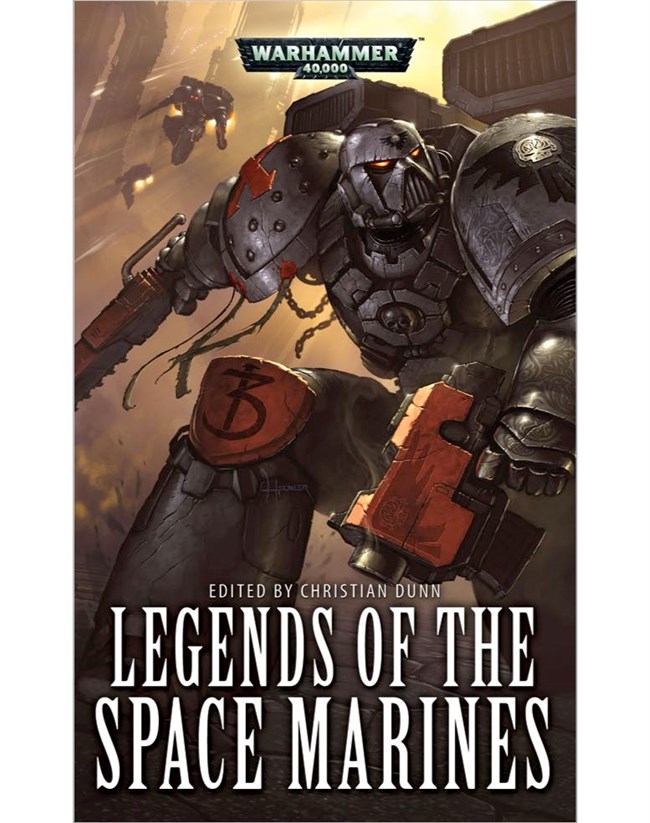
Heroes of the Space Marines - Legends of the Space Marines - (various)


Space Marines epitomise the war-torn Warhammer 40,000 universe. These short story collections focus entirely on these superhuman warriors, telling high action tales of heroism and savagery.

I decided to read these two anthologies back-to-back, for no real reason other than I thought it would make a neat two-for-the-price-of-one feature; the stories in the anthologies are all stand alone and make for bite sized forays into the battle-drenched world of 40K, although Nick Kyme’s Salamanders feature in both books, tying in with his Tome of Fire trilogy; his story “Fires of War” serves as a prequel to Salamander and his Tome of Fire trilogy.

I have to admit that I was expecting the stories to revolve around singular Space Marine heroes- there are characters in 40K lore whose names stand out from the rest and I was expecting (a.k.a hoping) that the anthology would be exploring their rise to legendary status; this was re-kindled when I saw “Legends” was on its way, but it was not to be (but then The Horus Heresy is already covering a lot of this ground one way or the other).

The ten stories that share the 408 pages of Heroes are a good mix of stories, opening with Graham McNeill’s “The Skull Harvest” which follows the continuing story revolving around Honsou, the enigmatic foe that features in his Ultramarines series. The stories race along nicely, averaging no more than 50 odd pages apiece (apart from Nick Kyme, who checks in at a greedy 79 pages, although it’s no hardship to remain in the Salamanders’ company for that bit longer).

My favourite offering of Heroes though has to be Steve Parker’s "Headhunted", which follows a Deathwatch kill-team as they board an Ork hulk and hunt down the Boss. The Deathwatch are a really cool concept, an elite, secretive group recruited from any of the loyalist Space Marines chapters and tasked with hunting down the most dangerous foes of mankind. It’s atmospheric, the characters are interesting, and it conveys a real sense of deadly urgency and danger- and does it all in 53 pages.

Legends, blessed with some fabulous cover art, weighs in at heftier 539 pages which are again shared amongst 10 stories and a wide variety of legions. It keeps to the same formula, providing a good mix of stories from different perspectives, with Paul Kearney’s The Last Detail being the one that stands out for me. Set in the aftermath of a titanic battle between the loyalist Dark Hunters and the chaos tainted Punishers, it follows the story of a native boy and his father as they uncover a survivor amongst the carnage, a setup that serves as a canvas for Paul to show the gulf between the Marines and the people who they are ultimately there to protect.

On the flip side, CS Goto's "The Trial of the Mantis Warriors" could have benefited from a tighter edit. Revolving around the thoughts of the Chaper Master of the Mantis Warriors as he is interrogated for alledged heresy, it drops into flashbacks of the events leading to the heresy which can work well. However, there's a deluge of new characters, places and Chapters in short order, and it's hard going figuring who fits where and who's doing what. I got it in the end, but only after going back and forth several times to work it out.

Overall, I really enjoyed these- the short stories are great for quick reads when commuting and the like, and each sports a good variety of stories that keeps them interesting, preventing them from becoming ten stories of different Space Marines shooting different aliens.

Sunday, April 18, 2010

Flesh and Iron - Henry Zou


From the planet of Solo-Baston, there come reports of an uprising. It seems indigenous forces are rebelling against Imperial rule, and a mysterious figure known as ‘Dos Pares’ is at the centre of the conflict. Into this chaos, the 31st Riverine Imperial Guard are dispatched to neutralise a vital battery of siege guns, and find themselves surrounded by hostile local forces. But what the regiment first dismiss as simple tribal warfare soons turns out to be something much more sinister and dangerous.

Ah, the imperial guard. Cornerstone of the Imperium. While the Space Marines might be the icons and embodiment of the 41st millennium, the men and women of the Imperial Guard are the glue that holds it together. Their lot is stand against the myriad of enemies that threaten mankind armed with only bravery and the strength of the man next to him, each as mortal and vulnerable as you or me. So when it comes to their stories, they’re an entirely different animal to those of the Space Marines; these men experience fear and terror, despair and weakness. And with that comes an obligation for the author to provide a story that strikes a balance between these factors, the ferocity of combat in the 41st millennium and the heroism that lifts and binds it all, and keeps the fans coming back for more.

With this in mind, Henry Zou has given us Colonel Baeder and his 88th Battalion of the 31st Riverine, a regiment hailing from a homeworld characterised by swamps and bayous, brought to Solo-Baston to capitalise on their experience with amphibious assaults. They’re selected to undertake an essential but dangerous mission into the heart of enemy held territory, and it’s from there that Henry really turns up the heat.

The oppressive environment of Solo-Baston is well described, and the difficulties of waging a war in that kind of setting carefully considered. There aren’t any glorious charges or massive pitched battles, only a series of brutal clashes and ambushes, the frustration of the guardsmen palpable as they inch towards their target and the fantastically claustrophobic, close quarters battle that awaits them.

What I appreciated most though was that the characterisation of Colonel Baeder and his leading men weren’t sacrificed in the desire to deliver on the action. They grew on me, and when they were betrayed,it struck a real chord, and frankly left me fuming on their behalf- and that's quite something to achieve, no matter what you're writing.

If I had any reservations, it would be that the after effects of the betrayal and Baeder's ultimate fate felt slightly rushed; however, the depth of the betrayal is such that you can understand the vulnerability it would expose, particularly after what they'd been through.

It didn't detract from my enjoyment of Flesh & Iron though- it's a fast, clever and brutally entertaining delivery for anyone who's a fan of military sci fi, whether of the 40K variety or not.